What surface, visible fibres and detail are acceptable? Define them with a target sample or clear description; completely invisible fibres are not promised.
UHPC & SPECIAL APPLICATIONS
Fibres for decorative UHPC.
Get the sample right first.
For thin elements, decorative panels and appearance-sensitive systems, define the target appearance and acceptance criteria before planning a controlled trial.
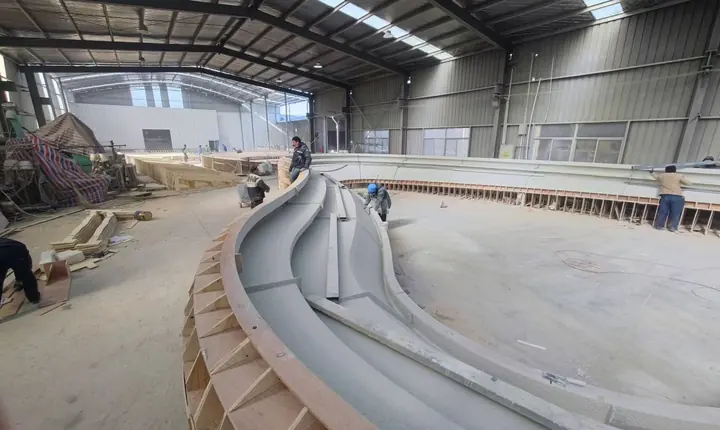
DEFINE THE SAMPLE
Appearance, dispersion, project performance.
Assess them separately.
These are evaluation dimensions, not photographs of test specimens, proof of translucency or measured results.
Can the actual system mix uniformly and achieve the intended casting? Record the mix and process, not just a photograph of an attractive surface.
What material, finished-product or structural performance is needed? Confirm through applicable methods and design; the UHPC name alone does not establish compliance.
CONTROLLED MIX TRIAL
One controlled trial.
One clearly defined question first.
No universal UHPC recipe is provided. A decorative-system trial is not presented as an alternative for every structural UHPC application.
Provide a target sample or use description
State thickness, geometric details, surface / translucency objectives, existing material system and acceptance requirements. A scene image does not replace your own sample.
Record the actual mix and dosing
Record binders, aggregate, admixtures, fibre batch, mass, mixing equipment and time. The website does not automatically formulate a mix.
Check dispersion, casting and surface together
Observe workability, fibre dispersion, casting, curing and the target surface under the project plan. Retain comparable photographs and abnormalities; no invented improvement percentages are used.
Judge against agreed criteria, not feel alone
Record appearance observations separately from specified performance tests. State reasons for parameter changes; arrange independent third-party testing when accredited evidence is required.
FIBRE TO EVALUATE
Check product identity first.
Then verify project performance.
This is a priority candidate for this application, not a final recommendation independent of the conditions. The product page is the source for full specifications and controlled documents.
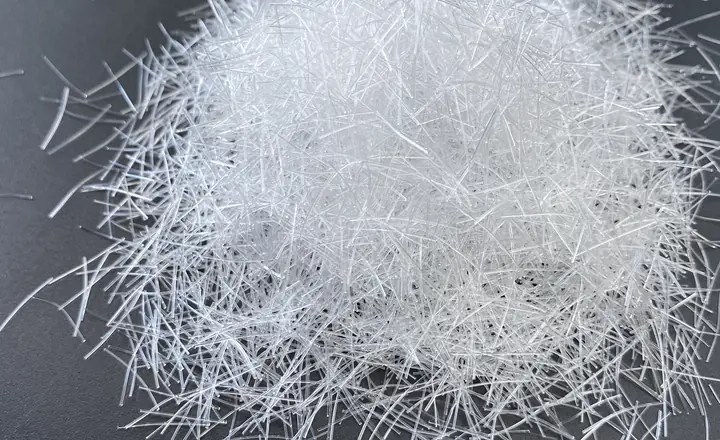
Product name as stated in the formal TDS
Modified PP 12
Transparent, fine, round modified polypropylene monofilament without physical indentations. For targeted trials in decorative UHPC, translucent concrete and decorative panels; not a statement of suitability for every UHPC system.
- Standard length
- 12 mm
- Equivalent diameter
- 0.20 mm
- Tensile strength
- ≥550 MPa
These are nominal TDS fibre specifications, not site concrete, component or support-performance results. Source: TDS Rev. 20260701.
TDS suggested starting range: 9–15 kg/m³.Confirm final dosage through project design, mix and actual process trials. Dosage alone does not establish energy absorption, residual strength or finished-product performance.
This is not a recommendation for every UHPC system.
The Modified PP 12 TDS addresses decorative UHPC and related products. A transparent fibre does not prove a translucent finished product. No structural steel-fibre substitution, universal compressive strength or post-crack performance is promised, and the proprietary modification formulation is not disclosed.
Editorial resources also cover controlled evaluation of Modified PP 12 in selected UHPC structural components as well as decorative components. Any structural duty requires responsible design, predefined methods and acceptance limits, and evidence from the actual mix, process and component. This is not a universal steel-fibre substitution or a pavement / bridge-deck recommendation.
Check packaging and dosing separately.
TDS: dose by mass. Remove outer packaging unless the actual supply is explicitly marked as water-soluble packaging. Add with binders in the normal sequence, then continue mixing for 3–5 minutes or until uniform dispersion is confirmed. Domestic supply: 10 kg / bag; export packaging by agreement. Low bulk density can increase shipping volume, so check volume as well as net mass when requesting a quote.
EVIDENCE & ACCEPTANCE
Samples show appearance.
Tests establish performance.
Record conditions for both. An attractive sample photograph is not a structural or optical-performance report.
Explore UHPC test dataMonofilament specifications are not UHPC properties
12 mm, equivalent diameter 0.20 mm and ≥550 MPa are nominal fibre specifications, not UHPC compressive or flexural strength. The TDS does not declare energy absorption or residual strength.
9–15 kg/m³ is a trial starting range
This TDS range applies to decorative UHPC and related uses. Targeted trials must confirm appearance, dispersion and performance; do not extend it automatically to other systems.
Separate reports from permission to publish
Obtain available documents from the product page. Customer mixes, samples and trial records are not published without authorization or reused as another customer's project case.
Laboratory boundary
Conchip operates a factory-internal laboratory; it is not accredited. Internal data support comparison and project discussion. Arrange independent third-party testing when accredited evidence is required.
BUYER QUESTIONS
Address the questions
that change selection.
Does a transparent fibre guarantee translucent concrete?
No. Fibre colour and finished-product translucency are different claims. Confirm optical characteristics, appearance and project performance through targeted samples and specified tests.
Can 9–15 kg/m³ directly replace steel fibres?
No. The range is not a basis for structural equivalence. Define the fibre role, design and method first; this page provides no universal substitution ratio.
Can we start without a complete mix design?
Yes. Start with use, geometry, target sample, equipment and existing problems, identifying unresolved conditions. For a confidential mix, provide only the information needed for evaluation; public disclosure is not required.
A USEFUL FIRST INQUIRY
Bring the target sample
to the next controlled trial.
Send the information available and mark unresolved conditions. Continue through Project / Technical Inquiry.
Send application and project conditionsReview the information → current TDS / SDS and method information → missing items and trial discussion. Response timing and the records available must be confirmed separately.
- 01Specific decorative / thin-element / translucent use and geometry
- 02Target-surface photographs or description and acceptable fibre visibility
- 03Available material-system information, equipment, mixing and casting limitations
- 04Trial dosage, curing, specified performance and acceptance method
- 05Sample quantity, export packaging / volume, destination and timing
Distribution / import: check documents and supply conditions.
Modified PP 12 domestic supply is 10 kg / bag; export packaging is agreed with the customer. Low bulk density can occupy more shipping volume, so quotes need packaging dimensions and loading conditions. Confirm shipment packaging, labels, destination, quantity and purchasing schedule individually. Stock and lead time are not assumed.
Distributor / Importer Inquiry →Technical procurement: include your specification.
List the formal product name, required document version, application, trial quantity and supply quantity. Product pages retain the controlled TDS / SDS links rather than duplicating conflicting document versions across applications.
Start a specification-led project inquiry → Trade sourcing route →Questions and technical answers
Related technical articles
Use these articles to prepare process information, trial records and evidence before selecting a project condition.
What Is Macro-Synthetic Fibre-Reinforced Concrete? Applications, Evidence and Limits
Understand macro synthetic fibre reinforced concrete, its application routes, performance evidence, production controls and limits before selecting a product.
Read more Why Evaluate Chemically Modified Polypropylene Fibre for UHPC Components?
Evaluate chemically modified PP fibre for selected structural and decorative UHPC components through interface, dispersion and component evidence.
Read more Why Does UHPC Crack at Early Age? Autogenous Shrinkage, Temperature, Restraint and Curing
Separate autogenous, drying, plastic and thermal effects in UHPC, then plan restraint, curing, monitoring and fibre trials around the actual component.
Read more Steel Fibre, Micro PP Fibre and 12 mm Modified PP Fibre: Different Roles in UHPC
Compare steel, micro PP and 12 mm modified PP fibres by engineering role and evidence path, not by kg-for-kg substitution.
Read more How to Plan a UHPC Trial with 12 mm Modified PP Fibre
Plan a controlled Modified PP 12 UHPC trial covering dosage, mixing, dispersion, early-age monitoring, material tests and component validation.
Read more