Start with the slab, placing process and finish
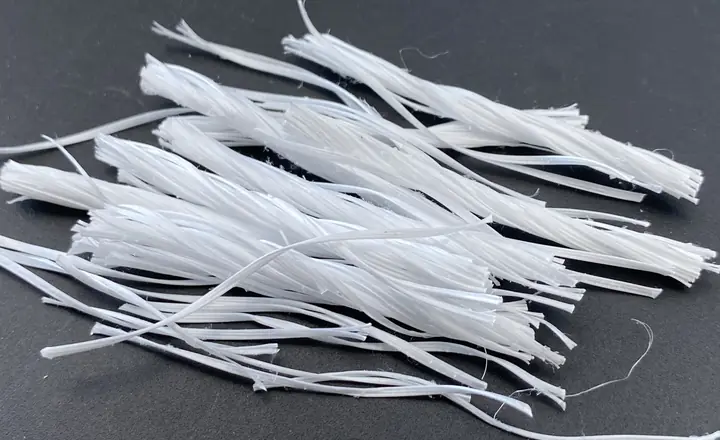
Twist Wave 50 is a pearl-white macro synthetic fibre made from a polypropylene/polyethylene blend with no other added additives. Each finished fibre is formed by twisting 20 flat monofilaments. The monofilaments have two longitudinal grooves created by the tri-linked extrusion profile and no surface embossing.
It is intended for industrial floors, concrete floors and slab applications when the slab design, concrete mix, placing method and acceptance plan are reviewed together. Start with the Industrial Flooring pathway rather than selecting from the product name alone.
Use 4–8 kg/m³ as a trial starting range
The manufacturer starting range is 4–8 kg of fibre per cubic metre of concrete. Verify the final dosage for the slab design, concrete mix, placing equipment, finishing process and specified tests. This range is not a structural design, a guaranteed residual-strength result or automatic approval to replace steel reinforcement or steel fibre.
Remove the ordinary PE bag before batching
Determine the batch dose by weight. Open and remove the ordinary PE bag before dosing. The bag is not water-soluble and must not enter the mixer. Add only the measured fibre with the concrete ingredients during the normal charging sequence.
Continue mixing for an additional 3–5 minutes after fibre addition, or until uniform dispersion is confirmed in a plant trial. Verify mixing, pumping or discharge, placing, finishing and surface acceptance under the actual production conditions.
Plan packaging, storage and site handling
Standard packaging is 2 kg per ordinary PE bag, 12 kg per carton and 504 kg per pallet. Keep bags closed, dry, protected from moisture, direct sunlight and physical damage. Make the bag-removal instruction clear in site and plant procedures.
Use the documents within their stated limits
The technical profile presents manufacturer-declared product specifications from TDS revision 20260701. Selected physical-property data are supported by commissioned report JCBG(01)250205945, tested to GB/T 21120-2018. The result applies to the submitted sample and is not a guarantee of every batch or a floor design.
Energy absorption and residual strength are not declared in this revision. The formal stamped report is not published. The EN 14651 method page explains a beam-test pathway where specified; it is not a Twist Wave 50 certificate or a prediction for a slab.
Open the current TDS and SDS. The product-specific SDS is a manufacturer reference document and does not remove the need to review destination-market requirements.
Send the floor conditions before requesting a recommendation
Include the slab duty and thickness, concrete mix, batch size, mixer, placing and finishing equipment, joints, curing plan, intended fibre role, proposed dosage and acceptance method. Add quantity, destination and schedule. Distribution inquiries should include target markets, flooring applications and expected volume.
Discuss a Twist Wave 50 floor project · Discuss distribution of Twist Wave 50