Application-first concrete fibre engineering[email protected] · WhatsApp +86 159 6543 3989
PRECAST CONCRETE PRODUCTS

Fibres for precast concrete.
Describe the element first.
Then compare the candidates.

Piles, panels, thin elements and other precast products should not all receive the same generic recommendation.

Start with the element
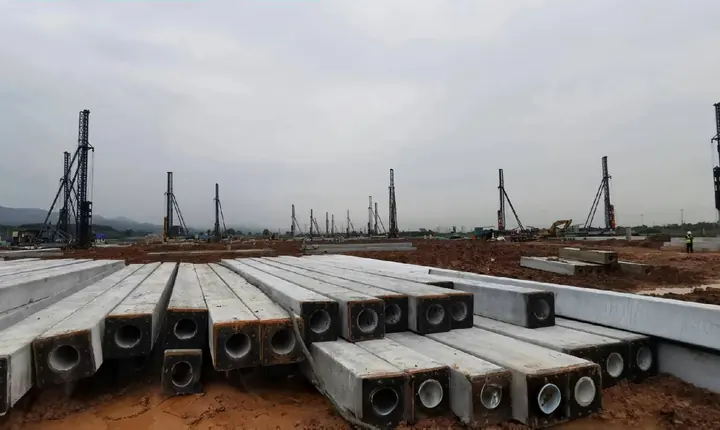
Precast concrete-product application scene
Application image; not evidence of a Conchip project.
WHAT DO YOU MAKE?

Choose an element type,
then complete the information needed.

Use the element type to review the information needed; this does not directly determine a product or structural performance.

Precast piles: clarify production and handling first.

  • Cross-section, length, existing design and the intended fibre role.
  • Casting, curing, demoulding, handling and service conditions. Replacement of existing reinforcement is not assumed.
  • Project-specified material / component tests and acceptance criteria.

Panels / thin elements: include appearance and casting constraints.

  • Thickness, geometric details, surface requirements and existing design.
  • Production method, dispersion, casting and curing limitations, and whether visible fibres are acceptable.
  • Verification of geometry, appearance, handling and project performance. Decorative UHPC has its own application route.
View the UHPC appearance and trial route →

Other elements: define acceptance before narrowing the candidates.

  • Element use, geometry, material system and production method.
  • Fibre objective: comparative trials, specified post-crack performance or another clearly defined duty.
  • Existing production problems, available data and the differences to verify.
For tunnel segments, use the dedicated component-verification route →
COMPARE IDENTITIES, NOT PROMISES

Indented or wavy?
Compare identities, not performance rankings.

These candidates require project verification. This is not a universal equivalence table, and raw material or shape alone does not establish concrete performance.

Check each product's identity, specifications and evidence boundaries, then review its product page and TDS / SDS. Shape or tensile strength is not a performance ranking.

Four precast candidates: product identity, specifications and evidence.
Formal product nameForm / specificationsCheck before selectionProduct and document source
01 / CANDIDATE FOR PROJECT VERIFICATIONHigh Strength 48Virgin PP; flat, diamond-indented
48 mm / equivalent Ø 0.95 mm / ≥570 MPa
Precast candidate; TDS starting range 4–8 kg/m³, subject to design and plant-trial confirmation. No residual strength is declared.Product details / TDS / SDS →
02 / CANDIDATE FOR PROJECT VERIFICATIONWavy Macro Synthetic Fibre 48Virgin PP; flat, longitudinally wavy
48 mm / equivalent Ø 0.95 mm / ≥570 MPa
Cast / precast candidate; TDS starting range 4–8 kg/m³. No product-specific independent third-party report is available for the wavy type. An indented product's report cannot establish equivalent results.Product details / TDS / SDS →
03 / CANDIDATE FOR PROJECT VERIFICATIONTransparent 45Virgin PP; round / flat / wavy, distinguished by form
45 mm / equivalent Ø 0.70–1.00 mm / ≥450 MPa
Suitability for basic precast applications requires project trials. Round / flat forms are indented; the wavy form is not. No universal dosage is declared.Product details / TDS / SDS →
04 / CANDIDATE FOR PROJECT VERIFICATIONRecycled 44Recycled PP; flat-column form with thread-like indentations
44 mm / equivalent Ø 0.80 mm / ≥350 MPa
Nominal values are based on manufacturer-internal data; no independent third-party report is claimed. No universal dosage is declared. Recycled raw material alone does not establish carbon savings or structural equivalence.Product details / TDS / SDS →

Sources: formal, non-DRAFT TDS; wavy type Rev. 20260820, other candidates Rev. 20260701. These are nominal fibre specifications, not finished-concrete or component-performance results.

The same base raw material and drawing process do not establish the same concrete-test results.

Indented and wavy forms can meet different customer shape preferences, but dispersion, production compatibility and finished-product results require separate verification. Any proposed shotcrete use of the wavy type, including dry mix, requires actual equipment and process verification. It is not directly recommended here as a shotcrete substitute.

A SMALL, TRACEABLE PLANT TRIAL

Keep the differences in the trial record,
not only in the product name.

A / CONTROL THE COMPARISON

Define the comparison objective

Select the element, mix and production conditions. Specify whether comparing dispersion, casting, appearance or a stated performance criterion, and record every actual change.

B / RECORD THE PROCESS

Dose by mass and observe dispersion

Check the supplied form and packaging instructions. Record loading, dosing, mixing, casting and curing; do not apply one product's packaging method to every fibre.

C / REVIEW ACCEPTANCE

Then decide the next batch

Identify appearance observations, internal trials and specified component tests separately. Review against project acceptance criteria before discussing supply and repeatability.

EVIDENCE & ACCEPTANCE

There may be several candidates.
Their evidence must stay separate.

Match each product's documents, each trial's conditions and every result explicitly.

Explore precast product test data

Do not omit product identity

State the formal name, form, length and batch. The different Transparent 45 forms must not be reduced to the generic label "transparent fibre".

Distinguish data sources

Commissioned physical-property reports, manufacturer-internal data and no product-specific independent report are different evidence states. Do not attach one product's report to another.

Evaluate the element with the relevant tests

Whether a candidate meets component requirements depends on the actual mix, casting, curing and project-specified testing, not its place in a tensile-strength ranking.

Laboratory boundary

Conchip operates a factory-internal laboratory; it is not accredited. Internal data support comparison and project discussion. Arrange independent third-party testing when accredited evidence is required.

Related public case studies

These cases describe individual projects. Laboratory measurements are listed separately in the test database.

A USEFUL FIRST INQUIRY

Send the element and the problem.
You do not need to guess the product first.

Send the information available and mark unresolved conditions. Continue through Project / Technical Inquiry.

Send application and project conditions

Review the information → current TDS / SDS and method information → missing items and trial discussion. Response timing and the records available must be confirmed separately.

  1. 01Element type, use, geometry and existing design requirements
  2. 02Current production method, equipment, casting and curing conditions
  3. 03The specific problem to improve / evaluate and available records
  4. 04Candidates to compare, if known, mix and trial plan
  5. 05Project acceptance criteria, quantity, destination, timing and document needs

Distribution / import: check documents and supply conditions.

List packaging and document needs under each formal product name. The TDS for High Strength 48, Wavy Macro Synthetic Fibre 48, Transparent 45 and Recycled 44 specify water-soluble film bundles and standard cartons of 5 kg / 10 kg; actual supply specifications still need confirmation. Confirm shipment packaging, labels, destination, quantity and purchasing schedule individually. Stock and lead time are not assumed.

Distributor / Importer Inquiry →

Technical procurement: include your specification.

List the formal product name, required document version, application, trial quantity and supply quantity. Product pages retain the controlled TDS / SDS links rather than duplicating conflicting document versions across applications.

Start a specification-led project inquiry → Trade sourcing route →